Urban Fantasy · 1996
Neverwhere
by Neil Gaiman
A London that runs on puns, and a second city hiding in its cracks.
A British-born writer whose fable-like novels brought myth into modern settings.
Gaiman first became known for comics, notably The Sandman, before moving into novels, with Neverwhere, American Gods, Anansi Boys and The Ocean at the End of the Lane among his best-known adult books. His work helped make modern-day mythology a mainstream strand of contemporary fantasy.
His prose is plain, rhythmic and storyteller-like, and he returns often to the idea that old stories persist in modern life. Readers who want a short, accessible entry can start with Neverwhere, while those who want a larger, more ambitious book can begin with American Gods.
Gaiman writes like someone telling you a story across a kitchen table. The sentences are short, the images are exact, and the strangeness arrives without a drumroll. He rarely explains a rule of his magic. He states a premise, such as a London whose place names turn out to be literal, and then lets the characters bump into it. That habit is why his books read quickly even when they carry heavy ideas. He also trusts structures borrowed from older forms. Neverwhere is a quest shaped like a fairy tale, American Gods is a road novel with folk tales tucked between its chapters, and The Ocean at the End of the Lane is a remembered childhood told in a few quiet sittings. The form changes from book to book. The storyteller's voice does not.
Three concerns recur. The first is that old stories do not die, they change clothes. Gods, tricksters and monsters survive by finding a new job in a new country. The second is the gap between what a child understands and what an adult has agreed to forget. The third is the ordinary person who falls through a crack in the world and must decide whether to climb back out. These sit under myth and folklore, but Gaiman is less interested in scholarship than in what belief costs the believer and the believed-in. His gods are tired, funny, petty and sometimes frightening. His protagonists are often mild men, and the books are partly about what happens when a mild man is handed a reason to act.
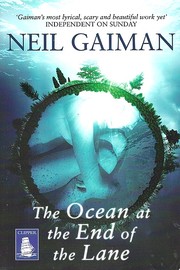
The four catalog titles are less alike than the author's name suggests. Neverwhere is the lightest on its feet: episodic, punning and adventurous, with villains who are funny and dangerous in the same breath. American Gods is the widest, a slow and discursive book about a whole country, and it asks for patience. Anansi Boys is a comedy of family embarrassment, closer to farce than to mythic grandeur, and it is the one most likely to make you laugh aloud. The Ocean at the End of the Lane is the shortest and saddest, a memory piece with real menace and almost no jokes.
Length and mood follow the same split. Two of the four are medium or short and fast to read, one is long and meandering, and one is short and heavy. Choosing among them is mostly a choice about tone, and about whether you want a story that wanders or one that marches. None of them needs a map of Gaiman's other work, and none of them is a mere sequel to another, so each can be judged on its own terms.
None of the four depends on another, so there is no required order. A sensible path starts with Neverwhere, which shows his voice at its most direct. If that works for you, take American Gods next for the large-scale version of the same idea. Anansi Boys is a good palate cleanser after it, since it shares a trickster tradition with a very different mood. Keep The Ocean at the End of the Lane for when you want something brief and emotionally exact. If you only want one, choose by taste. Readers who like puzzles and puns should pick Neverwhere. Readers who like long conversations and landscape should pick American Gods. Readers who want a short book for an evening should pick the Ocean.
Gaiman's closest relative here is Susanna Clarke, who also mines English folklore, though she builds a densely footnoted past where he builds a plain-spoken present. Next to Ben Aaronovitch, who also gives London a hidden layer, Gaiman is more fable than procedure: Aaronovitch asks how magic would be policed, Gaiman asks what it means. Both love London, but one maps it and the other dreams it.
Beside Erin Morgenstern he is less ornamental and more dryly funny, and he is happier to let a scene be a conversation. His influence on the wider field shows in books that treat folklore as living and portable. Readers who finish him and want that feeling in a different register can try The Ten Thousand Doors of January, or The Library at Mount Char, which is much harsher.
Skip Gaiman if you want tightly plotted series with a long arc, since his catalog titles are standalone and loose by design. Skip American Gods in particular if slow pacing and episodic detours wear on you. Readers who want rigorous magic systems will find his rules intentionally soft. Readers who dislike a narrator who comments on the story may prefer the close, plain voice of Jim Butcher, though that voice has its own jokes. Content notes in general terms: American Gods contains sexual content and violence, and The Ocean at the End of the Lane has frightening material seen through a child's eyes. Neverwhere and Anansi Boys are the gentlest of the four.
If you are standing in front of the four books and cannot decide, ask what kind of evening you want. A fast, funny one with a map of London in your head points to Neverwhere. A long one with motels and old gods points to American Gods. A family comedy points to Anansi Boys, and a short, aching one points to the Ocean. Matching mood to book matters more here than reputation, because the same author can leave you delighted or flat depending on the pick.
Urban Fantasy · 1996
by Neil Gaiman
A London that runs on puns, and a second city hiding in its cracks.
Contemporary Fantasy · 2001
by Neil Gaiman
A road novel about old gods stranded in a country that stopped believing in them.
Contemporary Fantasy · 2005
by Neil Gaiman
A comedy of embarrassed sons, trickster gods and a family inheritance nobody asked for.
Magical Realism · 2013
by Neil Gaiman
A middle-aged man returns to his childhood lane and remembers what he tried to forget.