
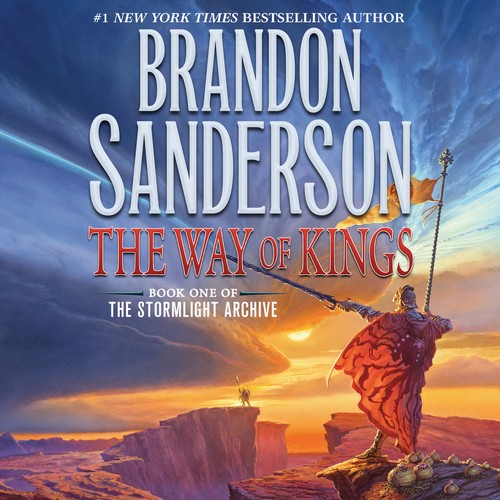
Cover image via Open Library, where available.
The Way of Kings
by Brandon Sanderson · 2010
A vast, storm-scoured world told through a few damaged people trying to keep their honor.
This is the opening volume of a planned long-running epic set on a harsh world battered by enormous storms. We follow several people who start far apart: a soldier turned slave, a young scholar chasing a forbidden project, and a highborn commander haunted by his own history. A long war on a barren battlefield and the politics of the people fighting it form the backdrop.
It reads as a very large book that rewards patience. Sanderson alternates between character-driven chapters and carefully seeded worldbuilding, with interludes that widen the picture. The final stretch pays off many of the earlier setups and moves faster than the opening hundreds of pages suggest.
Where it sits in the genre
Published in 2010, it is a defining example of modern epic fantasy built around clear, learnable magical rules, an approach Sanderson has made central to his work. It sits inside a larger shared universe the author calls the Cosmere, though you do not need any of the other books to read this one.
It continues the tradition of the big, multi-viewpoint epic while leaning toward emotional accessibility: characters who struggle with depression, duty and guilt share the page with spectacle. It is a good gateway for readers who want depth without grimdark cynicism.
Voice and structure
Sanderson writes in a clear, even close third person, and the prose is built to be understood quickly. Sentences rarely show off. What carries the book is arrangement: five parts, each opening with a short prologue-style scene, and between the parts a run of interludes that leave the main cast and visit strangers elsewhere in the world. The interludes look like detours at first and gradually read as a map being drawn from the margins.
The main chapters follow a few viewpoint characters in alternation, and a long flashback sequence is used to deepen one of them. Pacing is front-loaded with setup, patient through the middle, and then compressed, so the closing stretch feels earned by the hundreds of pages of preparation. Expect to hold a lot of names, but the book repeats key information with a teacher's patience.
Setting and magic
The setting is a land of stone and crem, where highstorms sweep from one side of the continent to the other and everything alive has adapted: plants that retract, animals with shells, buildings that face the weather. The ecology is a pleasure to read about, and it quietly explains why cultures look the way they do.
Magic is tied to oaths and to the spren, small spirits that cluster around emotion. Soldiers carry Shardblades and Shardplate, relics that make single fighters decisive in battle. The deeper system, tied to ideals, is only partly shown in this volume, and the book is open about holding most of it back. The cost is more psychological than physical: powers respond to who a character is willing to become, which makes the magic part of the character work rather than a separate subject.
Themes in practice
Duty and its limits drive the three main lines. One man serves in a war he no longer understands and keeps trying to protect those beneath him. One scholar is pursuing knowledge she is not supposed to want. One commander is troubled by visions and by the gap between his reputation and his memories. Each shows power and its cost from a different rung of the social ladder, and the caste system of the setting makes the rungs literal.
Depression and survival are treated plainly in scenes, not as a lecture. A character stands at an edge and the book lets the moment be quiet. Honor codes, and the cynicism people use to dodge them, run through every faction.
How it compares and who it suits
Compared with Mistborn: The Final Empire, it is slower, wider and more emotionally layered; Mistborn is the tighter first read. Compared with The Eye of the World, it also builds a vast world in installments, but with a modern attention to interior states and a more rigorous interest in how its powers work. Next to A Game of Thrones, it swaps cynicism for earnest idealism.
It suits readers who want a large, immersive epic with moral seriousness and a payoff for patience. It is less suited to readers who dislike long openings or who prefer ambiguity over explained rules. The series is ongoing, so treat this volume as the start of a long read, not a closed story.
How to approach the length
A very large book asks for a reading plan. This one is easier than its size suggests, because the five-part structure gives natural stopping places, and each part opens with a short scene that resets your attention. A sensible habit is to read a part at a time, take a break, and let the next part's opening remind you where you are.
The beginning is the hardest stretch because the book introduces a lot of invented vocabulary: ranks, customs, creatures, rituals. You are not expected to memorize it. Context teaches most terms within a chapter or two, and the occasional epigraph and glossary help. Our guide to long series has more on pacing a big commitment, and it applies strongly here.
Three leads, three kinds of burden
Kaladin, Shallan and Dalinar are written as three distinct responses to pressure. Kaladin is the soldier worn down by loss and by a system that treats him as expendable. Shallan is the young scholar who has a secret to protect and a plan that depends on lying well. Dalinar is the commander whose authority is real and whose private doubts are growing. The book keeps all three in view without letting any one dominate.
What makes the ensemble work is that their problems rhyme without matching. Each wrestles with obligation and with what it costs to keep a promise, and each answers differently. Compared with the cast of The Eye of the World, these leads are older in outlook and more willing to be examined from the inside. Compared with A Game of Thrones, they are more consistently allowed to want to do good.
The interludes and why they exist
Some readers skip the interludes, assuming they are filler. That is a mistake in this book. They are short visits to people and places outside the main plot, and they do two jobs: they show how the larger world works, and they plant details that become relevant later in the series. They also give the reader relief from the main story's heavy emotional material.
The craft point is worth noting for anyone interested in how epic fantasy is built. Sanderson uses them to widen scale without slowing the main line, a technique quite different from the digressions in older epics. If you enjoy that structure, the same instinct shapes the Cosmere novels more broadly, and Mistborn: The Final Empire uses a smaller version of it in its chapter epigraphs.
Where this sits among Sanderson's books
Sanderson has written several long series and a number of standalone novels, and this is the opening of the one with the largest ambitions. It shares a shared universe with his other work, but you do not need any other book to enjoy it. Treat the connections as an extra for later, not a prerequisite.
If you have not read him before, there is a real choice between starting here and starting with Mistborn. Mistborn is shorter, faster and more plot-forward, which suits readers who want to test his style cheaply. This book is the better pick if you already know you like large, immersive epics. The author page and the series page give more detail on how the books connect and in what order to read them.
Handling the heavier material
The book treats war, slavery, depression and the aftermath of violence seriously. It does not linger on cruelty for its own sake, but it does not look away either, and some scenes involve suffering on the page. Mental health is a thread that runs through the main characters, and it is handled with attention rather than as a plot device.
Readers who want a lighter read should know that the tone is serious for much of the length, even if the ending has a stronger sense of triumph than the opening suggests. For a contrasting approach to dark subject matter, The Fifth Season is harsher and more experimental, while The Way of Kings is more openly hopeful. Neither is better; they offer different reasons to keep reading.
A decision framework before you commit
Ask four questions. Do you enjoy invented worlds that unfold over hundreds of pages? Do you prefer clear rules to mystery? Are you comfortable starting a series that is still being written? And do you want a payoff that comes from patience rather than from early action?
If you answer yes to most, this is a strong pick, and the last section justifies the opening. If two or more answers are no, consider a more compact start such as Mistborn or a character-driven alternative like Assassin's Apprentice. You can always return to this one once you know the size and shape of epic fantasy you prefer.
Worked comparison with two other Sanderson-style starting points
Consider three ways into large-scale fantasy. Mistborn gives you a compact trilogy with a crisp plan and a young heroine; it is the fastest to read and the easiest to finish. The Eye of the World gives you a classic quest in a vast, slowly revealed world; it asks for patience and offers tradition. The Way of Kings sits between them in spirit, with the rule-minded design of the first and the world-scale of the second.
The practical difference is the kind of reward. Mistborn pays off with reversals, Eye of the World with accumulation and mood, and The Way of Kings with an ending that reorganizes what you thought the book was about. Which you prefer depends on whether you value speed, immersion or structure. If you are unsure, start with the shortest and see which part of it you wanted more of.
Audio, print and annotated habits
The book's invented vocabulary and many epigraphs make print a good format, since you can flip back to the map or a glossary. The audiobook is long, and some listeners enjoy it because the multiple viewpoints are easy to follow by ear, while others find the names harder to keep straight without seeing them. Our audiobook or print guide covers the tradeoffs in more detail.
A modest tip for either format: do not stop to look up every term. The book is designed so that confusion at the start resolves with context. If you still feel lost after the first part, a short pause and a glance at the map is usually all you need. Treat the early chapters as an investment, and the book returns the favor.
How it reads
- Multiple point-of-view characters with separate storylines that gradually converge
- A magic system tied to ideals, oaths and a strange natural cycle of storms
- Intricate worldbuilding: plants, animals, cultures and religions that feel invented from the ground up
- Flashback sections that deepen one major character
- A long build-up with a high-energy final act
Read it if
- You want an immersive, world-first epic with satisfying payoffs
- You like magic with clear rules and a sense of discovery
- You enjoy heroes who are tired and flawed rather than invincible
Maybe skip it if
- You prefer a short, fast read
- You dislike long setups before the main threads connect
Who it is for
Adult and older teen readers of epic fantasy. Contains war violence and mature themes handled without much explicit content; romance is light.
Reading notes
Start with this book; it opens the series. You do not need to read other Cosmere novels first.
Themes and tropes
Power and Its CostMagic SystemsEmpire and RebellionMemory and LossReluctant Hero
If you like this, try
Mistborn: The Final Empire
by Brandon Sanderson
It is Sanderson's quicker, tighter entry point to the same shared universe, with a heist-flavored plot.
The Eye of the World
by Robert Jordan
Jordan's series is the older model for this kind of multi-volume, multi-viewpoint epic, and Sanderson later completed it.
Gardens of the Moon
by Steven Erikson
Erikson shares the huge scope and war-weary soldiers but gives you far less hand-holding.
The Fifth Season
by N. K. Jemisin
Jemisin also builds a world around a natural catastrophe, with a harder emotional and political edge.


More by Brandon Sanderson
Epic Fantasy · 2006
Mistborn: The Final Empire
by Brandon Sanderson
A heist crew tries to topple an immortal ruler in a world of ash, mist and metal-fueled powers.